Thursday, August 13, 2020

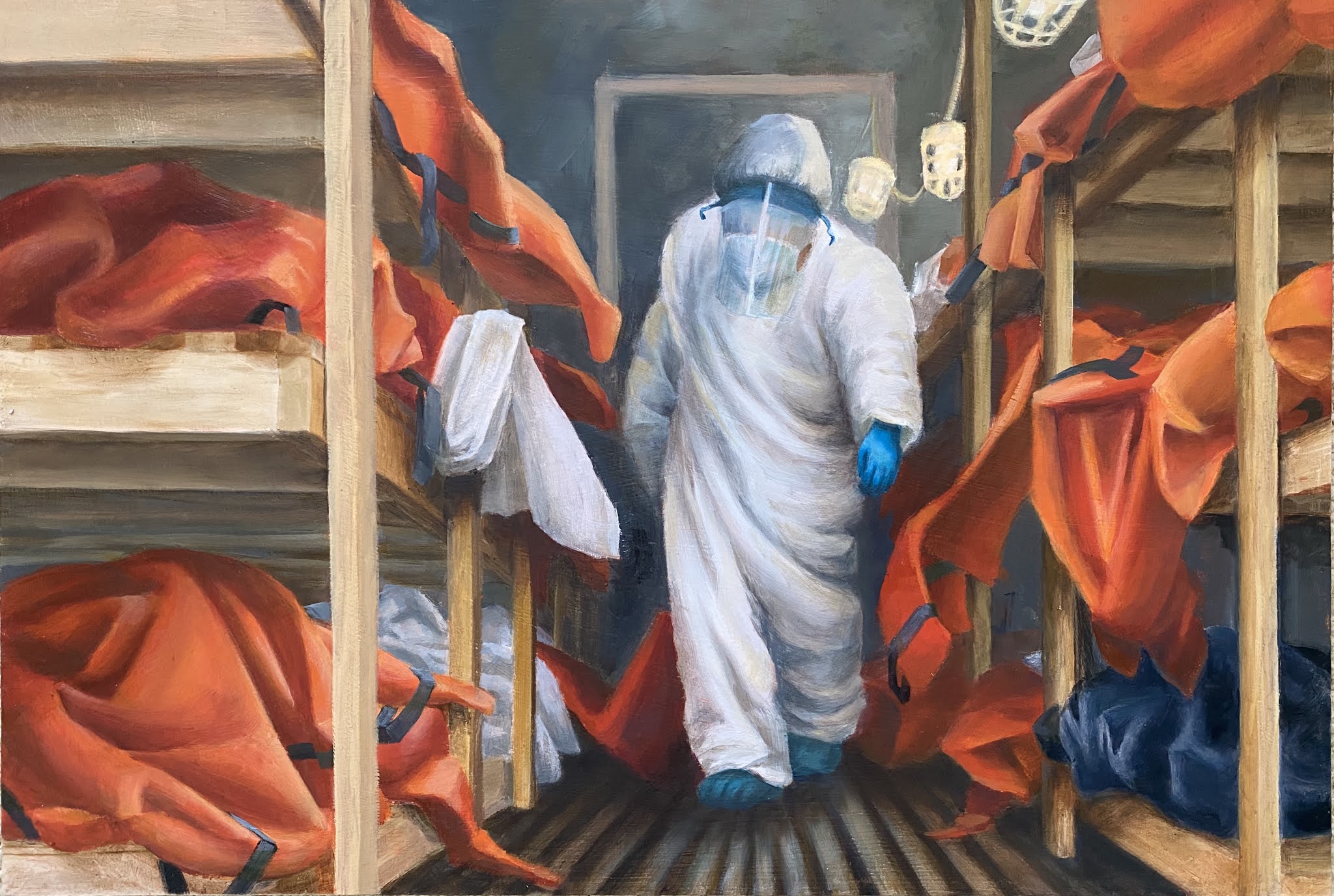
18 Wheeled Morgues


18 Wheeled Morgues
18x12 oil on Panel


The death rate in New York City overwhelmed its system for burying the dead. Someone in 

the city died every 2 minutes, four times the normal death rate. Hospital morgues, funeral homes and cemeteries overflowed and backed up. Hospitals ran out of body bags, military teams were called in to assist in mortuary work, and funeral homes were working around 

the clock. One funeral director said “the death rate is so high, there’s no way we can 

bury or cremate them fast enough.”


Refrigerated trucks were parked behind hospitals to serve as makeshift mobile morgues. Stacked on quickly built shelves, each truck could hold 36 bodies and store them until 

funeral homes could accommodate them. After dying without family or friends, the favorite aunt, the checker at the market, the teacher who had inspired kids year after year, 

the beloved spouse were stored in body bags in 18 wheelers.

Thursday, August 6, 2020

Playing to an Empty House


Playing to an Empty House
16x12 oil on panel

From road house to grand auditorium the sharing of music stopped. The uniquely human experience of coming together to enjoy live music was prohibited. Fleets of musicians have no income, musical institutions can’t sustain their losses and there is a creeping realization of how long this dark period may last. Originally thought of as a mere intermission in an ancient tradition it now appears that gathering for a musical experience may change forever.


Arias sung from balconies, orchestral pieces delivered by zoom and performances in darkened concert halls are sweetly tragic. Musicians need to play and people want the emotional experience that only music can deliver, but performance is interactive, among the artists and between musicians and their audience. The communion we feel when sharing

live music simply doesn’t survive social distancing.


Tuesday, July 28, 2020

Rewilding


Rewilding
20x16, oil on panel

Buffalo walked the empty highway in New Deli, wild boar roamed the deserted streets of Italian towns and wild turkeys strutted around Harvard Yard. The animals, always there, were free to reclaim their territory unabashedly. Isolated in our homes, these photos dredged up Hollywood versions of a post apocalyptic planet.


This scene was captured by my son who had ridden his bike across an absolutely empty Golden Gate Bridge. The usual line of cars climbing Muir Headlands was missing as were the knots of traffic near viewpoints. In the quiet a coyote stood squarely and met his gaze.


On a subsequent ride a bobcat, notoriously shy, trotted by him with a squirrel in its mouth and never acknowledged having human company.


Thursday, July 16, 2020

Night Shift


Night Shift
coronavirus series
16x12 oil on panel

Public spaces, now empty, were disinfected at night with fogging machines. The other worldly scenes this gave rise to made me wonder how far into Dante's circles of hell we had ventured.

Thursday, July 9, 2020

Intensive Care


Intensive Care
16x12 oil on panel

It’s a uniquely wonderful person who runs into a burning building to help others out or walks into a ward of infectious patients to try to help them through their illness. In both cases the individual knowingly risks their own well being for the sake of another. Usually someone they’ve never met and will probably never see again. Our communal safely rests on these people. They are the fibers of the safety net that catches us when disaster strikes.


When the virus landed hard in New York City and Intensive Care Units were at capacity there was a shortage of Personal Protective Equipment. This meant that doctors, nurses and medical technicians were being placed at risk while assisting the ill.


I again found myself asking, how could this be in a country that has prided itself for its readiness to produce and deliver anything the marketplace needed nearly instantaneously? Aren’t medical supplies foundational to disaster planning? 


I was struck by how uncomfortable the needed protective gear is that medical professionals were fighting for. Layers of nonporous materials, awkward disposable outer layers and face, hair and eye protection. Have you ever tried to breathe through an N95 mask? Every breath is a struggle. 


These people are running into the fire for our sake. They bring years of education and training into one grey room after another to do their best to heal and when they can’t they hold the hands of our friends and family as they pass away. The least we can do is provide the medical community with everything we possibly can to keep them safe. 


Monday, June 29, 2020

Sorry, We're Closed


Sorry, We're Closed
Coronavirus series
16x12 oil on panel

As the stay-at-home orders began to reshape our lives, our eyes moved from the large public spaces that were empty to the more intimate gathering places that had been ordered to close. Restaurants, where we go for conversation and community as much as for food were shuttered. First the idea that lunch with a friend or a casual cup of coffee was not possible was a shock, then the realization of the depth of our troubles crystallized seeing all the "Closed" signs. Dread of the economic fallout took hold. Not only were individual workers doing without needed income, but how many businesses could survive being shut down for a couple of weeks? As weeks turned into months we knew that a second disaster was taking place all around us. All those closed doors indicated another form of silent suffering that would take an enormous toll in a whole different way.


Tuesday, June 16, 2020

Helping From Home


Helping From Home
16x12 oil on panel

As the stay at home orders were issued across the country it was stated that our rare trips out would require a mask. The shortage of personal protective equipment immediately became so severe that those whose lives depended on it, health care workers and first responders, were going without. Workers in essential services from grocery store employees to postal workers also needed to wear masks every day and they were in scarce supply. 

Brigades of women pulled out their long forgotten sewing machines, dusted them off and got to work. Patterns were shared and how-to videos sprung to life. Heroines like Stephanie Oddo, who organized the Healthcare Mask Collaborative, delivered donated fabric and elastic to a wide circle of people who produced thousands of masks at home and delivered them to medical facilities and military groups. 

The juxtaposition of sitting at a sunny table in a quiet house and making masks in the hopes of saving the lives of people on the front lines of a pandemic was startling.  I thought of World War II volunteers who helped hospitals suffering from severe shortages, collected scrap metal for reuse and planted Victory Gardens to supplement food rationing. But the United States had built the most stunning consumer society the world had ever seen since that time. We now face overwhelming choices and companies promising to goods faster and cheaper. 

How could this have happened?